Instagram

Friday, September 4, 2026

My Mammy's Story

 Today I was going through some of my old genealogy files, and I came across what I could call an autobiography written by my grandmother in 1992. She wrote this and submitted it to her JONES cousins for their family history book. 

This is her story, in her words:

Winnie Sue Jones (Nall) was born on July 14, 1936, in San Antonio, Texas, to John Arthur Jones and Lurie Myrtle Rutherford Jones. Their fifth child. I have two brothers; Edwin Arthur. and Charles Newton, two sisters: Leona Frances (Chilcoat) and Myrtle Lou (Shaw) and one brother Momma and Daddy's first born, who died at birth. Known only as "Our Baby" and is buried beside my Father in the Truscott Cemetery It's easy for me to give this writing and it starts many years ago I can't remember anything about my Father, I don't even remember how he looked or any kind of an encounter with him, I'm sorry to say. All I've heard has been above and beyond good and fair. A very loyal worker and Husband and father. At all times a dedicated man in all respects by all who speak of him.
Edwin, Frances, Charles, Winnie, John Arthur, and baby Myrtle Lou


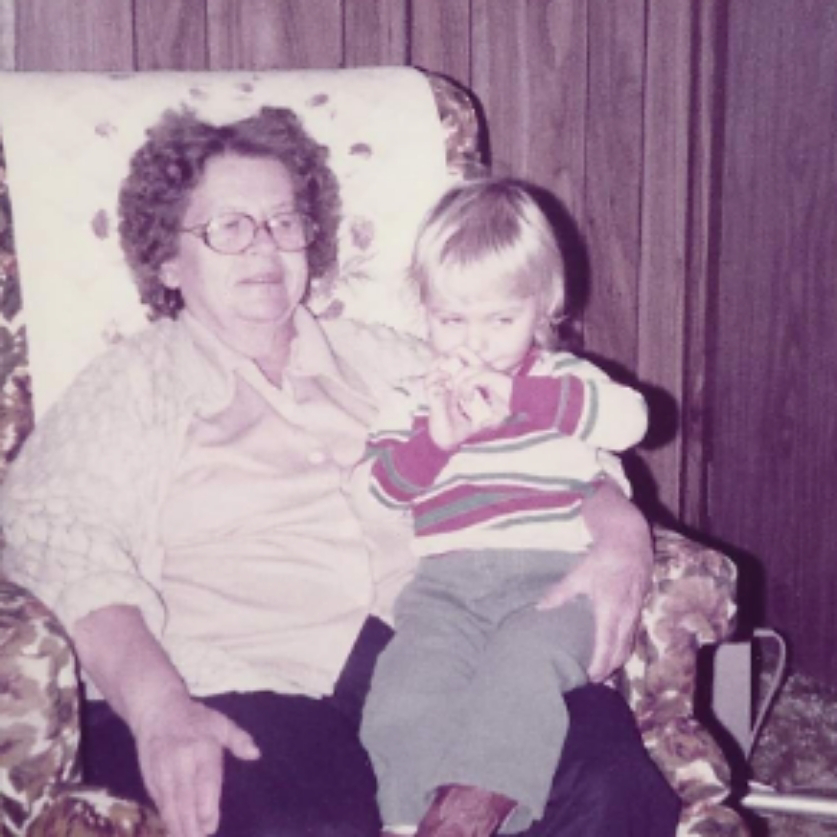
My mother is another story I don't remember much except the earliest recollections I have living in Truscott in the house next door to Burton Jones (no relation) over in the south part of town. I can remember playing a lot and swinging in a swing in front of the house and one of the dearest families that lived behind us. This was Carlton Browder and Lois. They had Doris Marie and Opal Jean Browder. I loved to go over to their house. and did on several occasions. But some of the trips I came home much faster than I went over. You see Momma came after me with a "switch" and used it on me. Of course, I had not gotten permission to go and mother wanted us to be good and not bother anyone. It was hard for me because I loved people at a very young age. Then the next memories are of living over in the north part of town in the Oilie Turner home. Where cur neighbors were to the west of us was Mrs. Adcock to the south another dear friend Mary Kathleen Chowning who lived with her grandparents Mr. and Mrs. Mart Chowning_ The John BuEtions • to the east of us was Mrs. Ethel Chilcoat and family - to the north of us was the Charlie McNuses and Mr. and Mrs. Ozzie and Susie Turner. All of whom remember being only the nicest of people. have absolutely no bad memories of my childhood Momma made sure we stayed in Our yard. Of course, there was a white picket fence so there was no trouble with boundary • "stay in the yard"! Meant stay inside the picket fence. The earliest memory of school was I guess in second or third grade. Mrs. Jack Brown was my teacher in fact ALL of our teachers - and I loved her. The people in Truscott were really good and dear people. I can remember Myrtle Lou would cry when she started to school - she wanted mother, but mother went back home, so Mrs. Brown would have me sit with Her (Myrtle) when Charles was having a lesson and have Charles sit with her when I was having a lesson. I don't know how long that went on. I am sure it stopped at some time or another. When my next teacher was Mrs. Lelah Jones - and I was scared to death of her she was just very strict and stern and I didn't quite understand that, was used to a lot of kindness. Truscott was a small place, but people with great heart. So many people the names if I were to start would number a hundred or more. Some more of them were Aunt Idoma Chowning who was substitute teacher a kind compassionate lady always. VBS where everybody seemed to help. Lumber yards gave scrap wood and materials which could be used in craft All the community would donate something. People would donate their time in harmony for all time in harmony for all us kids to have and to learn. Mrs. Irene New - she always played piano while Jimmy and Peggy New and Charles and Winnie Sue sang. Gus Gustaphason was a quaint man. He came to the school system to teach children to learn and learn they did. He roomed in the back room off the porch at our house. He was a very quiet, almost strange, but I really admired him for his teaching ability I guess mother couldn't afford very many tree decorations at Christmas time and I think no lights. That year Mr. Gus brought home all the decoration and electric Christmas lights and gave \hem to me telling me to get mother to put them on our tree and she did, I can't remember if I was in the 6th or 7th grade. Then our school house burned in 1945 and we had to go to school at Benjamin. When I was very young - I remember Uncle Jim and Aunt Lula. We would go to their house for a visit I guess and they would always give momma milk and eggs. Uncle Bill Jones and Aunt Lorene would bring big fish - which momma would can in fruit jars (with the bones in) and we could eat them like sardines, even eat the bones. They had been pressured in the pressure cooker and too, Aunt Lorene always brought peaches or fruit cocktail and angel food cake - and chewing gum, a package for each of us. Then at Christmas time every year, We always got a bushel basket of fruit, mostly grape fruit and oranges. We never really knew but momma thought it was from Uncle Jasper and Aunt Winnie. We went to daily Vacation Bible School every year. I just couldn't wait from one year to the next. We got to sing - make crafts and do Bible drills not to say anything about refreshments every day. It was great. I remember my dear Sunday school teachers Mrs. Frank Brown, who encouraged us as juniors in Sunday school to come every Sunday and be 100% every Sunday - for one year without missing a Sunday We did not know we would be rewarded - we were just learning to be 100% in everything we did for the Lord, I'll never forget she gave me a white BIBI-F and Charles Jones a black BIBLE. We always had Gideon's Testament but this was a real Bible. I was so happy and proud. I remember with very fond memories Bro and Mrs. Claude Harris - was pastor when I joined the First Baptist Church in Truscott as a child. It was a revival in the summer under an old brush Arbor - on the vacant lot next to the Church. I gave my life to Christ and have tried to be a person Christ would not be ashamed to know. In the summer there was always a tent show come to Truscott and set up on the vacant lot across from the Post Office and Bryon Bates Grocery. Mother would take us and go - we'd walk every step of the way knowing if we were good on the way home we could have a snow cone - after the show. We were never lucky enough to get one of those boxes of candy with a prize and maybe 5 pieces of paper wrapped candy. But know our eyes got big when everybody else opened there's - and we could see what they got. Mother was a very good mother to us and I say that from the bottom of my heart. She taught us well to have manners - to study - to learn about God -to respect others and the Ten Commandments. I never realized how hard mothers' life was until I got older. I remember she would iron clothes for the public until early hours in the morning, She canned Peas and chicken or whatever the farmers would bring her on the halves - knowing it would be food for us kids. We always had fried chicken, and biscuits and gravy Momma always had chickens. One time I remember momma raising baby chicks in the bathtub in the house. She put newspapers in the tub and then their food and water of course our bathtub didn't have water in it. In fact, every bath we had in that tub had to be drawn up early in the morning from the tin tank and warmed by the sun, then taken in and we bathed. Then we had to carry it out and put it somewhere outside that needed water. We had peach trees and whatever garden items mamma could raise. Edwin was in the World War II and Frances lived with Brother and Mrs. Strickland in Crowell to help with the income, I guess. It seemed as though Edwin and Frances were never really there. It was always Momma, Charles, Winnie Sue and Myrtle Lou. There were lots of good times at our house. We three could play a lot. Charles always wanted to be a cowboy and Myrtle Lou and I would play dolls - we had to make up our bed and hang up our clothes and keep our room clean and had tc help in the kitchen set the table and wash the dishes and dry them We had to sweep, Charles always had to mop then. I guess Momma would wax the linoleum, and Charles would take turns putting Myrtle and myself on the old blanket all over that floor. After we were through it would shine like new money. If we missed a place Momma would make us go back and do it over, but it seemed fun not work. We would spend lots of late afternoons in the front porch swing Momma would sit in a chair and Charles, Myrtle and I would swing in the porch swing and sing, lots and lots of songs. I guess that was my favorite pastime was singing. Then when Edwin came back from service he and Warren Haynie, Clyde Bullion and somebody else but I can't remember who (along with some girls and I don•, remember them) would play guitar, mandolin, fiddle or what have you and sing. We three Charles and Myrtle and I could go and listen if we would be nice and before long we knew the words to all their songs and could sing as good as they could. A singing home is a very Happy Home, and ours was. I can also remember getting up in the dark, putting on our clothes; Momma got a flash Ight and hurried us down in the cellar, A cloud coning! Boy did we get in a hurry. Once we were safe in there Momma would light the Kerosene lamp which always stayed in there with matches which stayed under the lamp and kept dry. The spider web and the musty smell cf that ole safe haven "the Cellar" I can remember as well as if I were there right no". We kids were scared until Momma would go to the door lift it JP a bit and tell us we could come out nu. be so glad to get back to our own beds. There was always canned goods in the cellar especially Vinson dad had killed. Sausage which Momma made and canned and peaches. Momma canned both plain and pickled peaches (my favorite). It seemed like a lot of nights found us getting ready to go to the cellar and coming back. I learned later in life that was Momma only way tc keep us safe from the storms. I remember gong to the post office every day white Edwin was in service to see if we got a letter some time yes and most times no. I remember so well the postmaster Mr. Tarpley always smiling down at us Mr. Bryon Bates and his wife in the grocery store. Mr. Meyers the Drug store and the cafĂ© where all the good smells came from - but we were never allowed to go in. Caram's grocery store - where Momma did most of her grocery buying. But for the life of me I could never remember her buying anything. Momma made her own lye soap - Uncle Jim killed the one hog. I can remember, while us kids were at school, thinking it would bother us. But what bothered us more was standing over the wash pot stirring the fat to render for lard. We all had chores - on wash day Momma was boss she ran the sorting and putting in dirty clothes and running them through the wringer. Each one of us kids stood by our tub and rinsed up and down, then with careful supervision put them through the wringer never getting our fingers caught. I'm not sure of the year but Grand Pa Jones (JC) lived with us. Everybody seems to think he was a complaining old man. I never found him so though - he liked his load a certain way. He always cleaned everything even the yard and chicken yard had to be kept clean according to Grandpa Jones. I remember him getting a cake through the mail and it had green frosting. He thought it was ruined and scraped all the frosting off. The rest of the cake was fine. He loved to play dominos; he would say, "Sister when you get through with your work come play me a game of dominoes." And I would. He always beat me though We lived just one block from school and we would come home for dinner. Well, I always wanted to get back as soon as possible, but Momma would make me sit at the table until just enough time to get to school thinking I would learn to eat. But I was more interested in getting back to play. The minute she said I could go, I'd tear out of there and start around by Grandpa's window, where he would be waiting for me. He’d knock on the window with his gold band and motion for me to come to the window. He unlatched the screen and handed me a piece of candy and said, "You better go sister.” Boy I'd travel, got to school though before the bell would ring. When Momma found out he was handing me candy. She must have asked him to stop, because he told me Sister I can't give you any more candy. Grandpa Jones was one of my favorite people. He was quiet and kind but could really look at you quite stern. By the same token. he could smile the nicest smile. Mostly he would just nod his head in approval. I remember Momma and Daddy's first real house was built by Daddy and how Momma talked about their bed and Ed and Frances slept on the bed that slid under their bed about the stove and table and how they didn't have much but she always glowed when she talked about "Our House" Hers and Daddy's first real home. I remember how grandpa bought it for $100 told Myrtle, "Now Sister it is still yours and you get it back when I'm gone." It was at Uncle Jim's house the last knew about it. It had a lot of trunks in it. Things that belonged to Auntie and someone else. I don't remember who. When the school burned, we had to go to school at Benjamin. It was so big and so different for me, anyway. I didn't have much confidence in myself. I was afraid of the men teachers - Mr. Isbon, Mr. Kirk; I had Mrs. Stoner for Home Eco - Mrs. Vera Hahn for English. I just did a turn around. I didn't like school. I was afraid of all the teachers. I didn't feel a part of anything. Lost interest somewhat, I remember on my eighth grade graduation, Someone and we never knew who - bought my Corsage and my first real nylon hose. I felt bad because I didn't know who to thank. I sang a solo the night I graduated "Some Enchanted Evening" and Mrs. Irene New played for me. I still have the program and the words to the song until this day. I have my daily vacation school certificate dated June 1948 and June 1949. The last one dated May 1950. Then in 1951 a perfect attendance for going 9 months to school without being tardy or missing a day was still doing the best I could do. That year my life really took a change. I got really interested in this young Roughen Country Boy - very different to me. Forward, not shy, not bashful - somewhat aggressive - and I never settled back down to school or lessons, oh I got them. They were easy - but I was more interested in him. He asked me one day if would like to make his coffee and wash his clothes and of course I said yes - so I got my engagement ring in February and was 16 in July - and married September 18, On Momma's anniversary. Not realizing how I hurt Momma. She would not say. She only showed me, by being somewhat different to me. Charles Nall and I have been married 40 years this year. We have four grown children; Charles Michael 39 years. Johnny Mark 36, Cathy Marilynne 34, and Jeannie Melinda 32. We have 9 beautiful and healthy grandchildren from 17 years down to 5 years - 4 grandsons and 5 granddaughters. Charles worked on the Beaver Ranch when we first got married. His boss was Bill Ryder. We both had a lot of growing up to do, me more so than he, I couldn't believe all the dirty dishes - and dirty Levi's. I had no washing machine and had to rub them on the rub board. That was different too. Then we moved to Seymour and he went to work in a small grocery store. $40.00 weekly 60 hours - I was lonely and he was busy. So in ‘53 now our first baby was born. Beautiful Baby Boy with golden hair. Then Charles went to work for M-System Super Market - Lots more work, lots more hours, lots more loneliness for me. Then we bought a rundown shack in the South East part of Seymour. Worked on it every possible hour. Finally we had a beautiful home of 4 bedrooms, 2 baths, living room, and a large den. kitchen, and dining room. Where John, Cathy, and Jeannie were all born - all in Seymour Hospital. Charles continued to work long hard hours. We went to church at First Baptist Church for a while and then moved our membership to North East Baptist Mission. Charles still working many hours. And very dedicated to his job. His Mom and Dad lived across the road and needless to say Mike was very spoiled. Then John Boy swallowed a safety pin at 10 months and 28 days old. He had walked everywhere at 8 months. In one week, he would have major surgery to remove that pin which had been drawn down into his lungs - but with God's help and good doctors - John came through really good. It never slowed him down. He is a very strong dedicated worker until this day. Cathy was always our dainty petite daughter - very lady-like in every manner - and Jeannie was born seeming healthy but almost starved to death for 4 months. She could not tolerate any kind of milk or milk substitute- at 5 months they sent her to Dallas Children's Hospital and told us to prepare for her death, which could not. I just asked God to take over, and I gave her to him. I was so tired of seeing her suffer. The doctors at Children's Hospital put her on a meat base - coco cola - rice cereal and pears which she lived on for 2 years. Then finally food, she is well and a very delightful daughter and mother of 3 healthy kids.


Jeannie, Cathy, Winnie Sue, Johnny and Mike

We have moved to Arkansas out on the farm to raise broilers and cattle. It has been work feeding from 24,000 to 40,000 broilers a day by wheelbarrow and manpower. Lots of work. Inside where it was dry - lots of work. By 1978 all of our children were married. All graduated with high honors and have gone to do their thing- Charles and I still have this big workplace. So, we cut down to 24,000 every 9 weeks, but it's lonely. We have a garden and he ventures into a poultry and beef processing plant. Lots more work, so 1977 as we learn to manage a balance of taking care of chickens and running the processing plant. It is busy but it seems to give us a weekly income, as the broilers going out every 8 to 9 weeks didn't do; their pay came all at once. It had to really be spread out. We always got chickens at, on, or near Christmas. Charles B had a severe heart attack in 1984, unable to hold out for any work for 4 years. Finally, he can do some light farm work. He has had to change his entire life because of his health. He checks cattle. Has a few hogs. can't stand much stress but is getting better. Charles had angioplasty in April 1985. Which helped him in his ability to do more? He now has yearly visits to the hospital, but he is doing fairly well with all his problems. He bales the hay, checks cattle, and does his best around home. We are members of New Sulphur Freewill Baptist Church where he has served as deacon for 6 years. A very dedicated Husband, Father, and Deacon to his church. A respected man of the community. and is still just Charles. We live down the road from Charles Mom, Willie Nall. my mother-in-law. whom I love dearly and have been as close as a mom to me. 


Monday, August 24, 2026

Patrick's Favorite Job


Patrick began working for a paycheck at the young age of fourteen at the only restaurant in town willing to employ someone that young, Braum’s. He spent three years there before moving on to Fratelli's Wood-Fired Pizzeria, which was owned by Don and Tracie Lurie at the time.

Several years later, he would still remember his time there as his favorite place of employment.

Besides making pizza, he also split the wood used for their pizza oven.

If you want to try his favorite pizza, it was the FratKat. He would substitute prosciutto speck for the prosciutto cotto.

Below is a video of him showing off his dough-throwing skills for his sisters and me.

Thank you for taking the time to remember our son, brother, and friend. Be sure to look for his memorial brick on the sidewalk out front. 


Monday, January 19, 2026

Unforgotten: When the Records Tell a Different Story

Some stories are long remembered, passed from one generation to the next without anyone stopping to question them. But when we take the time to look deeper into the existing records, we sometimes discover they weren’t entirely accurate — and in rare cases, they may not have happened at all. This is one such story.

In the winter of 1897-1898, newspapers across the United States began printing a shocking story.

According to the reports, two small children belonging to a man named George Coakley, livingsomewhere near the Arkansas–Oklahoma–Missouri border, were left home alone while their mother visited a neighbor. When she returned, the papers claimed, the children had been attacked and almost entirely devoured by pigs.

The Mena Weekly Star, Wed 29 Dec 1897

St. Joseph Gazette, Fri 24 Dec 1897

Arkansas City Traveler, Thur 23 Dec 1897

The Southern Standard, Fri 7 Jan 1898

This is the kind of story that stops you cold — and that’s exactly what it was designed to do.

But once I started digging into the records, I discovered something odd.

There was no George Coakley living in that region in the years surrounding 1897.

No children that are suddenly gone from the picture.

No death records.

No coroner’s inquest.

No local reporting on this family at all.

Nothing in the county courts, the census, or the surrounding communities.

Yet the story appeared in newspapers all around the country, as far away as California and even Maine — all with identical wording.

History remembers this late‑19th‑century reporting style as Yellow Journalism. At this point in time, I'm convinced the Coakley story didn’t actually happen. It was completely fictional sensationalized journalism meant to sell papers. Sometimes, in order to be the first paper to report the story, publishers would jump the gun, reporting predicted outcomes and partial truths. Like this one about the Newsom-Jones family.

Daily Arkansas Gazette, Tue 12 Apr 1898

Further research will later reveal that only "the old gentleman Newson" had actually drowned.
Arkansas Democrat, Wed 20 Apr 1898
This family was originally from Parallel, Washington County, Kansas where the following article ran three months later.


The Linn Digest, Fri 22 July 1998

And in Washington County, Kansas
in 1883 there's a marriage record form William W Jones and Louise J Newsom


Evidence that Mr. William Jones did not drown that day in the Spring of 1898, alongside his mother-in-law, comes whenever he is found alive and well two years later, enumerated in the 1900 census in Cane Hill, Washington County, Arkansas as a house carpenter. Notice most of his children are born in Kansas.


This location makes sense considering the mention of Muddy Fork in the article that reported the three drownings, which is located along the road that would have taken them from Cane Hill in Washington County, to Fisher Ford, Siloam Springs, in Benton County, where William Jones' in-laws, the Newsom's resided.
1903 Plat Map of Township 14 Range 32 


Evidence that his mother-in-law also survived any tragic accident resulting in her death is also found in the 1900 census, where she can be found living alone as a widow in Hico, Benton County, Arkansas, age 65.


These two stories remind me of a story that's been passed down and printed about my own 4th great grandfather's death. The story is told that he was beaten and murdered by Bushwhackers while he was working on his property near Fallsville, Newton County, AR. It's said he died in his wife's arms while his brains "ozzed out into her lap". 

One of my first YouTube videos was about this man's daughter and in that video, I mention the brutal deaths of James Boen and his in-law's at the hands of neighbors turned Bushwackers.  


Cemeteries: Evans, Oark, Patterson Springs, Yale by Evans and Dewberry pg 227


I also mention the discrepancy of military records indicating he died in hospital Crystal Hill 12 Aug 1862


So which account tells us the truth? The military record lists only the initials J. M. Boen — nowhere does it name him as James Monroe Boen. And the very next entry is for Jesey (sic) Boen, grouped later with Jesse Boen who is also recorded as “died in hospital at Camp Hope 27 Aug 1862.” Two Boens, both dying in hospitals within weeks of each other, both recorded only by initials or misspellings. Is it possible the bushwhacker story is true, and the hospital death was mistakenly attributed to the wrong man?

Find-A-Grave, Camp Nelson 
So, when I sift through these old accounts — whether it’s a fabricated tale printed to sell papers, a rushed report that got the facts wrong, or even a family legend shaped by grief — I’m not trying to take anything away. I’m trying to give something back. In families like mine, where bushwhacker violence was not just a rumor but a lived horror that claimed fathers and brothers, it’s easy to see how trauma could shape the way a story was told and retold. But once the records come into view, we owe it to the people we’re remembering to separate what was feared from what was documented, and to let the truth stand on its own. Accuracy is a form of honor. Truth is a form of remembrance.

In the end, the truest honor we can give is to remember them rightly.

Saturday, January 17, 2026

The Unforgotten -- William D Shaw

Welcome to my series about the unknown, yet unforgotten people I encounter through genealogy research. These are individuals for whom few records remain—many who likely didn’t reach adulthood, left no descendants, and are otherwise lost to time. Some stories survive only because one person cared enough to write a few lines in a fading newspaper. Today’s post begins with one such man—William D. Shaw—whose brief notice preserved the memory of two people who might otherwise have vanished entirely from the historical record.

In May 1859 he published in the newspaper, a death notice for a man named Sewell Cavin, who had been in his employ for nearly two decades, as well as the death of a beloved Cherokee woman who had tragically drown in the Grand River.

The Arkansian - 21 May 1859

Further research reveals that Sewell Cavin did indeed purchase 4 parcels totaling 320 acres of land in Washington County, Arkansas, along Moore’s Creek and Muddy Fork, at the junction of what is now Fat Nash Road and Bethel Blacktop near the Rheas Community in the years 1838 and 1843.


Adjoining Sewell's land and purchased on the same date in 1843 was an 80‑acre parcel belonging to Michael Asher.


And in Washington County there is a marriage record for Michael Asher and Lucretia Caven three years later in 1846.


That same year, also in Washington County, Elizabeth Cavin married William Buchanan, and then ten years later in 1856, Martha Cavin married Marcus BuchananMartha named her first child, born in 1857, Sewil (sic)—likely in honor of the man whose name appears in the death notice. 


In the 1850 census, Martha—then age 17—is enumerated in the household of William Cavin, age 61, and Mary, age 58, in Marrs Hill, Washington County, Arkansas.

These records leave me wondering: was Sewell an older unrecorded son of William and Mary, remembered only in the quiet ways families keep their dead alive, by naming a son after him.

No additional records for Sewell Cavin have surfaced so far.

Unfortunately, the only records I have found for a Cherokee woman by the name of Jane Ketchum, are all dated well after the date of her death.

Even if very little of Jane’s story remains in the written record, the fact that Sewell died in the manner he did on the day after her demise, shows how deeply she mattered to him. Even without documentation, the impact of her life is unmistakable.

And this brings me back to Mr. William D. Shaw. Several records indicate that he was involved in Indian affairs. He appears to have been associated with the Western Creek Agency, and he was also active among the Cherokee at Fort Gibson. While no census record can be found confidently as him. He does appear in several military‑related accounts as a blacksmith, in the testimony of various government proceedings and the Gilcrease Museum preserves a note requesting that he "pay Drew and Fields $17.46" in part of their John Drew Manuscript Collection. I also found a surviving letter in the Gilcrease Museum’s online collections revealing that Shaw corresponded very personally with John Drew, they were more than mere associates, they were family friends.


Other records in the Gilcrease collection mention Shaw alongside the name Lanigan. Researching these names together gave me the bigger picture. They were the proprietors of the Mercantile at Fort Gibson. 

Times Record, Fort Smith, Wed, Feb 5, 1913, Page 6

The online library of Texas Tech also has a letter from Alfred B Green returning their license to "trade with the Cherokees".


Living amongst the natives in Indian Territory very few typical genealogy records have been found. So, I decided to search more diligently in old newspapers and in doing so have been able to piece together a much more complete picture of his life and more importantly his family, individuals who would otherwise be lost and forgotten: his very own son, Houston R. Shaw, who died in 1843 after a three‑week illness, his wife, Delilah Rogers Shaw who died 26th Feb 1857 and another son Robert G. Shaw, who died in Nov 1859.

Perhaps this is why Shaw published the death notice for Sewell Cavin and Jane Ketchum—because he had known the ache of personal loss and understood how fragile remembrance could be in a time when society was less connected, and records could all too easily be forgotten to history.


Arkansas Intelligencer
Van Buren, Arkansas • Sat, Dec 30, 1843Page 3


The St Louis Republic, Fri Dec 23, 1859

The St Louis Republic, Thur March 19, 1857


Weekly Arkansas Gazette, Sat March 14, 1857


Every so often, a small clue—a name, a line of print, a forgotten notice—reveals a life worth remembering. This post begins with one such clue: a death notice written by William D. Shaw, a man whose own story began as elusive as those he tried to preserve.

In gathering these fragments, we do what Shaw once did: we carry their names forward, so they are not forgotten.


Thursday, January 15, 2026

The Unforgotten -- Ransome Collins

Welcome to a new series about the unknown, yet unforgotten people I encounter through genealogy research. These are individuals for whom few records remain—many who likely didn’t reach adulthood, left no descendants, and are otherwise lost to time.

One of them is young Ransome Wilson, the firstborn son of Cinth
a Jane, named after her father, Ransome Collins.

Cintha Collins married Charles Wilson in Benton County, Arkansas, in 1872.


Over the next six years, they had three sons: Russel Ransome, Francis Marion, and Robert Elisha.


By 1880, Charles was no longer in the picture. The census lists Cintha as divorced, living in Hico, Benton County, just below her father’s household. Her boys were then ages seven, four, and one.

Eight years later, tragedy struck, when thirteen-year-old Ransome didn’t return home after a Saturday evening hunt. His body was found in the woods the next day by a local newspaperman, J. Van Butler. The coroner ruled the cause of death as an accidental discharge of the young man's gun.

Pineville News 30 March 1888

No gravestone for Ransome appears in any of the local cemetery records. But his maternal grandparents, the grandfather for whom he was named, are buried in Hico Cemetery. It seems likely that Cintha would have laid her son to rest near her own parents.


Sadly, the original Hico Cemetery was desecrated in the early 1970s during a city utility expansion. The stones were removed and discarded, and the graves were shoveled over. When residents learned what was happening, they demanded the project be stopped and the headstones returned. But most had already been destroyed. With no way to identify the exact locations of the remaining graves, a monument was erected, and the few salvageable stones were placed in a circle.


It’s plausible that Ransome Wilson is among the “unknown” listed on that memorial sign.


Sunday, March 19, 2023

The Unforgotten - The First Edith Lenora Sauser

I must warn you, this blog post is tragically sad and is the inspiration for my Unforgotten Series.

Years ago, when researching my step-father's side of the family, I came across a conundrum that took me literally five years to solve.

Let's begin with my step-great grandmother, Edith Lenora SAUSER. 


She was the daughter of Paul Frederick SAUSER and Orpah Annette SCHNOOVER who were married in Johnson County, Iowa, 27 July 1911. According to her birth certificate, she was born 07 October 1911 in Prarieburg, Linn County, Iowa. Paul was 23 and Orpha was 28. Edith was born after just 2.5 months of marriage. 


As I began to work my way up her tree, I came across an article published three years before her birth, mentioning her father, Paul SAUSER. It was a plea for divorce by a Margaret SAUSER who claimed abuse and wanted custody of their ONE YEAR OLD daughter, EDITH LENORA SAUSER. 


The Courier; Page 3, Waterloo, Iowa, Mon 30 March 1908

I immediately began investigating this Margaret but couldn't find a marriage record on Family Search or Ancestry. I also began looking for records for an Edith Lenora SAUSER born 1907 and all the results were either completely wrong or records that I knew were MY Edith Lenora SAUSER born 1911.

Years passed by before I thought to search beyond Ancestry and Family Search. I instead turned to google and searched for archived marriage records in North Dakota. I ended up at the State Historical Society of North Dakota. I did a vague search, only entering SAUSER for the groom's last name and then the year 1905 and got exactly one hit. 


SAUSER/BEATTY 

Notice this tells us Paul's middle initial is the same as MY Paul FREDERICK.

The next information I found were two Waterloo, Iowa, city directory entries for Paul F SAUSER, wf Margaret V, for the year 1906 when he worked for the Iowa Dairy Separator Company and 1908 when he was listed as a boilermaker. 


By 1910 I find Paul F SAUSER living in Boulder, Linn, IA, with his brother John M. SAUSER. His marital status was marked 'D' for divorced. 


I then began looking for Margaret V. BEATTY. I found her in the 1900 census as VIOLA M. BEATTY age 12, birth state, Illinois, the daughter of James W. and Edith BEATTY, living in Whitewater, Dubuque, IA. 


And in the 1905 Iowa State census she's enumerated in Cascade, Dubuque, IA as Margaret V BEATTY, listed with J W BEATTY, now widowed.

I then find two obituaries for Margerett's mother, Edith and it creates more questions than answers. 

The first obituary is from page 5 of Monticello Express 11 Dec 1902. It states, "Mr. and Mrs. BEATTY had no children of their own but their hearts were full of sympathy for the little ones who were without parental care"
And the second obituary from page 5 of the Cascade Pioneer, published in Cascade, Iowa on Friday, December 12th, 1902 goes on to name the foster children as "Margaret BEATTY, Mildred RAFFETY, Myrta DAVIDSON, Elon RAFFETY, and Linnie SHOTWELL" 

I searched and searched for Margaret Viola BEATTY SAUSER in the 1910 census but could find no trace of her or the one-year-old baby, Edith Lenora SAUSER, mentioned in the 1908 article. 

I kept searching and found a marriage record in Jackson County, Missouri on the 21 Dec 1918 for a Margaret V BEATTY, born in 1888, to a Charles PRATT. I decided to look for them in the 1920 census to see if this Margaret was also born in Illinois and sure enough, they're living in Kansas City, Jackson, Missouri and she is indeed born in Illinois. But there is no Edith Lenora born in 1907. It's only Charles and Margaret PRATT.

I continue to research this couple and discovered sadly, two short years later, Margaret died from pulmonary tuberculosis. Her death certificate goes on to list her parents as David E. GLENN and Mary L. CLARK. I begin to second guess myself. Maybe this isn't the right woman after all. But when I find the obituary for Margaret, I get some answers..... and more questions.


Page 4, Cascade Pioneer, Thursday, November 30th, 1922


So now I don't know who Margaret's birth parents were and I don't know why baby Edith Lenora born 1907 wasn't with her in 1920 or mentioned at all in her obituary. Did Paul get custody? Was my Edith actually 4 years older? Did they falsify records? Was her birth certificate accurate? Was Orpha SCHNOOVER not her mother after all?

Or, more likely, maybe the first Edith Lenora SAUSER died. Babies died often back then. I could find no birth record or death record no matter how much I searched. I laid everything aside and decided to come back later. Maybe a few days would give Ancestry's algorithms a chance to catch up to all the new information. 

When I came back, there weren't any accurate hints. They all are records for my grandmother born in 1911. But I hit "search" one last time and a Find-a-grave record comes up for an Edith SAUSER born in 1906 and died 24 March 1930 in Oklahoma County, Oklahoma. I feel this is unlikely to be her so far away but the inscription on her stone makes me decide to dig a little further. 

EVEN THOUGH ALONE IN LIFE NOT FORSAKEN IN DEATH


I decide to once again turn to old newspapers, and the pieces began to finally fall into place and her tragic story unfolds. 

Edith had been adopted in 1908 to a Mr. and Mrs. A B HECHT according to an article I found in the Waterloo Daily Courier dated 03 July 1908. 


Two months later a pair articles found running back-to-back in the Semi-Weekly Reporter, give us a little more insight into this story. 


Although, it should be noted that Margaret's troubles with the law were reported in September 1908, two months after giving little Edith up for adoption in July. I also would like to make note that other articles from 1904 in North Dakota can be found where a Violet Beatty and a Kate Brown get in trouble for vagrancy while hanging out with a "snake eater" from the local carnival named "Bosco Kelly".

But Margaret's story is a tale for another time.

It's now 1910 and Edith SAUSER, now going by the name Hazel HECHT, is enumerated with her new parents Albert and Maude, an older brother Kent, as well as a roomer named Irma Mills. They are living on Locust Street, in Waterloo, IA


Because I feel her story is so important, I want to take the time now to point out a few details that we can see from this particular census record. First, notice highlighted in blue, where this is Albert's second marriage and Maude's first. Then highlighted in pink is the columns asking how many children had been born, and how many were still alive. Maude is not Kent's mother. He was born to Albert and his first wife, Minnie SPIKE. Iowa birth records indicate that Albert and Maude did however have a baby girl, named Mary Elizabeth in April 1895 but by May she had sadly passed away. Whether the number 2 indicates Kent, or Hazel, we may not know for sure, but considering Maude is also marked as (inf) for informant, leads me to believe she was counting Hazel. 

In 1912, however, Albert's wife and Hazel's new mother Maude, tragically passes away from a meningitis. Notice that her husband, Albert worked for the same company Paul SAUSER did in the 1906 Waterloo, IA, directory. 


By January of 1920 Albert HECHT had left Iowa and was remarried to a woman named Jessie. The new family is now living in Pomona, Los Angeles, California. This time Hazel isn't listed as his "daughter", but instead as his "adopted daughter".


In June of that same year, Hazel Edith Hecht graduated 6th grade from Washington Elementary

Progress-Bulletin, Sat, 12 June 1920

And the very next year, at the tender age of 14, an announcement is made of the marriage of Hazel Hecht to Alphia O HART, a newspaper man working for the Pomona Press, originally from Enid, Oklahoma. 

The Lahoma Sun, Fri 23 Sept 1921


As it would turn out Alphia was to become a pretty prolific and well-known newspaper photographer. Because of this, we have the following picture he must have taken while he and Hazel were dating.


The Los Angelos Time, 25 Dec 1921


This marriage would be short lived, missing the "seven-year itch" by one year, when the marriage ended in 1927. According to an article in the McCurtain Gazette, a "simple divorce decree was granted in Garfield County." I can only find a one-line statement published in The Enid Daily Times, dated Sept 3, 1927 that simply says, "Hart vs Hart, divorce granted." She is only twenty-one.


Three months later, in the neighboring county of Noble, once again going by the name Edith Sauser, and living in the Rock Island Hotel, the following advertisement is made: 
The Billings News, Fri 02 Dec 1927


After this we come to the culmination of her life in a series of articles that detail her last few years when all the papers begin reporting her self-inflicted death, by poison. 

She ended up in Oklahoma City, working as a waitress at the Topic Cafe located at the 200th block of West California Ave, right below where she lived in the Oliver Hotel


Oklahoma City, Oklahoma, City Directory 1930


In January 1929 she had given birth to an "invalid son" at Holmes Home of Redeeming Love in Oklahoma, City. 


Holmes Home of Redeeming Love 

Edith struggled to make ends meet and with a life filled with one unimaginable heartbreak after another, her depression was too much to bear. The stress and struggle led to her own failing health. She was a waitress making $16/week. Because of sympathy and her good nature, her employer, C. C Whiteside, paid her more than the going rate. But life was just too cruel because even when you're making more than the average waitress, without any kind of familial support, she was unable to provide and care for her young son while also working enough to earn the money they desperately needed causing Children's Service Bureau to take him.

I imagine that was the last straw, and she decided to end her life by drinking poison. Her last words: "I'm to blame for everything."

There were no shortages of articles published in the month after her death, detailing her sad life's story. Edith just so happened to have kept a scrapbook with clippings of all her memories, most of which were painful. They told the story of her life. The last entry in her scrapbook was reported as being a "flimsy" that said, "Get the hell out of Oklahoma!" and I guess she chose suicide as her way out. As the news brought to light tragedy after tragedy, everyone became aware of her heartbreak, they shared it and it reverberated throughout the community. Even though she was destitute and could only have afforded to be given a pauper's burial, the funeral home, Marshall & Harper, chose to donate her casket and shroud as well as pay for her burial plot. One woman in the community, tragically remembered Edith had answered an advertisement she placed for a housekeeper and now she regretted she had not offered her the job. One thing was abundantly clear, Edith loved her son and was doing all she could to provide for him. It's my greatest hope that this somehow reaches someone who can help me find him, something that will carry her story another generation further. What was her son's name? What was his fate?

**In coming here to polish up this blog post before turning it into a video I actually made a remarkable discovery. Edith's story caused the public to look more intently into her "invalid" son, and according to an article in The Oklahoma News, :


So, here's to a woman whose history and existence was only to be found in Newspapers for those who would take the time to connect the dots. 

If her son survived and has heirs, I hope they one day find this information. I have no idea what his name was, first or last, or who his father was.

Here's a picture side by side of Grandma Edith and her half-sister by the same name. As well as a picture of their father in later years. 


Until next time
Becky 


I recently heard the following song that made me think of young Edith...